

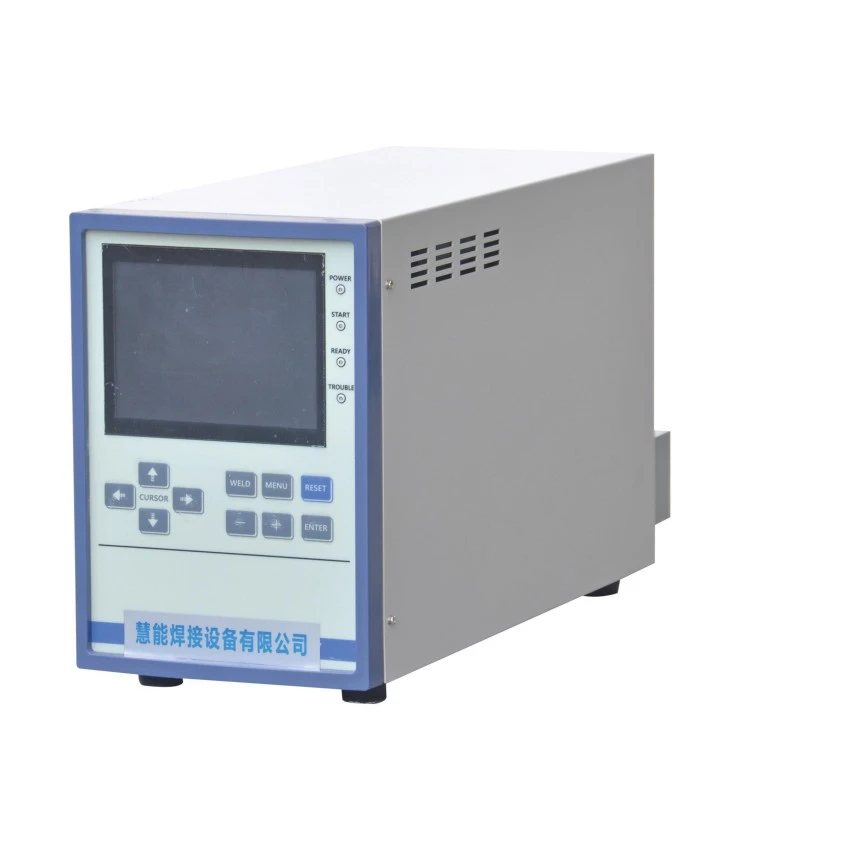


Products Description
The resistance weld controller is the intelligent control core of a resistance welding system, responsible for precisely regulating critical process parameters such as current, time, and pressure to ensure consistent weld quality. The controller receives commands from the operator panel or host system, precisely controls the welding energy output by managing the transformer's conduction angle and energizing time, while monitoring the welding process in real-time.
Widely used in automotive manufacturing, new energy battery production, motor and electronics assembly, and appliance manufacturing for spot, projection, seam, and butt welding applications.

Key Advantages

1. High-Precision Welding Control
Equipped with high-performance DSP chips or microprocessors, achieving control accuracy down to the millisecond level (e.g., 0.2ms) with fast response times. Supports multiple control modes including constant current, constant voltage, and constant power, ensuring precise and stable energy output.
2. Rich Process Programming Capability
Stores multiple welding schedules (JOBs/programs), supports three-stage heating (preheat, weld, temper/downslope), and allows multiple pulses with current upslope/downslope functions. Accommodates diverse welding requirements for different materials and thicknesses.
3. Real-Time Monitoring & Quality Control
Built-in current monitoring with configurable upper/lower alarm limits - automatic alerts and fault code display when current exceeds limits. Advanced models support welding data logging and traceability, with USB export of welding logbooks in Excel format for process visualization and data-driven management.
4. Adaptive Mains Voltage Compensation
Automatic compensation for grid voltage fluctuations - when supply voltage varies between +15% and -25% of nominal, output current variation is controlled within 2%, ensuring consistent weld quality regardless of power supply conditions.
5. Flexible System Integration
Standard RS485 communication interface with MODBUS protocol enables easy networking with PLCs and robot control systems. Robot-dedicated welding controller solutions available, ideal for high-volume automated production in the automotive industry.
6. Data Retention & Reliability
Critical parameters retained for up to 10 years without power, ensuring process data integrity. Comprehensive fault self-diagnosis and protection functions automatically shut down output and display fault codes upon anomaly detection.
Control Modes Explained
The resistance weld controller supports multiple control modes, allowing users to select the optimal mode based on welding process requirements.
Principle: The controller samples welding current in real-time and dynamically adjusts SCR conduction angle or PWM duty cycle via PID algorithms, maintaining constant output current regardless of grid fluctuations or load variations.
Applications: Galvanized steel, aluminum alloys, and other materials with high current stability requirements; situations where changes in weld joint position cause loop impedance variation.
Advantages: Excellent nugget size consistency, minimal spatter, stable weld quality.
Principle: The controller maintains constant primary or secondary voltage of the welding transformer, indirectly controlling welding energy.
Applications: Welding processes with low sensitivity to electrode force variations and relatively stable loop impedance, such as nut and bolt projection welding.
Advantages: Simple control loop, fast response, suitable for many conventional welding applications.
Principle: The controller simultaneously monitors current and voltage, calculating and maintaining constant welding power (P=I×V) in real-time.
Applications: Materials with significant resistance variations during welding (e.g., dissimilar thickness combinations), and processes requiring precise heat input control.
Advantages: Combines the benefits of current and voltage control, offering the highest energy control precision.
Principle: Builds upon constant current control with conduction angle compensation for finer heat regulation - referred to by some controllers as "constant heat" mode.
Applications: Precision welding processes with strict quantitative heat input requirements.
Hot Tags: resistance weld controller, China resistance weld controller manufacturers, suppliers, factory, ac transformer welding machine, Resistance Welding Transformer, spot welder timer controller, spot welding machine controller, spot welding machine time current controller, welding inverter transformer